SynObs & Ocean Observing Co-Design, Joint International Workshop

Home
SynObs aims to maximize the value of integrating measurements from diverse observation platforms—such as satellites, in situ sensors, and coastal or open-ocean systems—for ocean and coastal prediction. Its goals are to determine the most effective combinations and impacts of these platforms through observing system design and evaluation, and to develop assimilation methods that harness their synergies.
——— SynObs Workshop registration CLOSED ———
Website for Participants
DOWNLOAD THE LATEST ANNOUNCEMENT
This workshop will show progress made in the project, and highlight the importance of the collaboration with partners such as the Ocean Observing Co-Design programme and GOOS.
SynObs is a UN Decade endorsed project under the ForeSea programme.
Motivation & Objectives
Motivation
Ocean observations are an essential component for a wide range of societal applications, across spatial scales from global to local, and temporal scales from days to decades. Their value is realised not only through sustained observing networks, but through their effective integration into numerical models, data assimilation systems, and impact assessment frameworks that translate observations into actionable information. In turn, models can also be used through sensitivity experiments, to optimize the ocean observing system.
This workshop aims to bring together everyone working across the full value chain of ocean observing system co-design, including observations and data management to modelling, data assimilation, and impact evaluation, to exchange experiences, assess progress, and plan future activities. In particular, this workshop aims to integrate the achievements made so far by SynObs and Ocean Observing Co-design, and to plan their future activities. By linking observing system co-design with modelling-based evaluation, synthesis techniques (including emerging AI/ML approaches), and societal impact assessment, the workshop seeks to strengthen the feedback loop between observations and models. This integrated perspective is essential for guiding the design, optimisation, and sustainability of future ocean observing networks and for ensuring that observations deliver maximum benefit to science, services, and society.
Main Purposes of the workshop
- Development of data assimilation and other techniques for effective use and impact assessment of ocean and interface observations
- Evaluation of the impact of ocean observations on ocean, weather and climate predictions and other applications
- Sharing experiences of co-designing ocean observing systems
- Planning future activities of SynObs and Ocean Observing Co-design and their collaboration
For further details go to Themes
Date and location
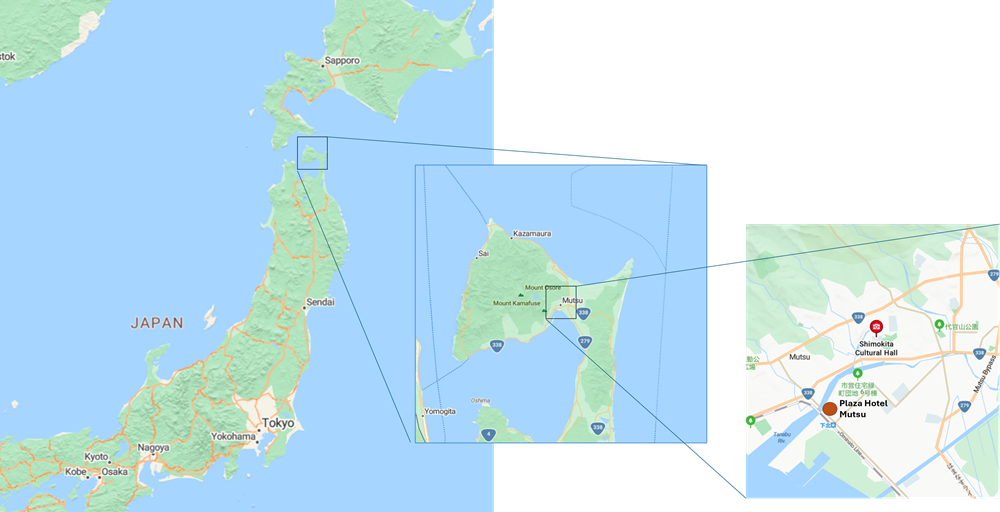
The workshop will take place at the Shimokita Culture Hall, Mutsu, Japan from 24-29 August 2026.
Themes
Four main themes of the workshop have been identified:
- Development of data assimilation and other techniques for effective use and impact assessment of ocean and interface observations
- Evaluation of the impact of ocean observations on ocean, weather and climate predictions and other applications
- Sharing experiences of co-designing ocean observing systems
- Planning future activities of SynObs and Ocean Observing Co-design and their collaboration
These themes have associated sub-themes (the list is given below). Please use the check boxes below to let us know what sub-theme your abstract is contributing to.
- Theme 1
- 1.1 Data assimilation and other synthesizing methodologies (including AI/ML) for effective use of ocean (physical and BGC) and interface observations.
- 1.2 Observation data processing, quality control, delivery and other applications for improving use of observation data.
- 1.3 Methodology for the observation impact assessment and optimal design of the observation network (OSEs, OSSEs, adjoint sensitivity studies, ensemble-based evaluation, etc.).
- Theme 2
- 2.1 Achievements of the coordinated experiments for the observation impacts (SynObs Flagship OSEs).
- 2.2 Evaluation of synergy between satellite and in-situ observations or among various in situ observation platforms.
- 2.3 Evaluation of air-sea interface observations for model forcing fields and data assimilation.
- 2.4 Observation impact studies for the social benefit applications close to end-users (including applications for fishery, marine transportation, marine ecosystem management, marine pollution, etc.).
- 2.5 Observation gap analysis and model uncertainty assessment
- Theme 3
- 3.1 Strategy, methodology, and best practice for co-designing ocean observing systems.
- 3.2 Co-designing ocean observing networks across coastal-shelf-deep sea continuum: synergy between open-ocean and coastal observations (i.e., interaction between boundary currents and coastal/regional seas, polar ocean/sea ice).
- 3.3 Use of ocean observing system evaluation in guiding co-design of ocean observing systems.
- 3.4 Co-designing the ocean observing system for better understanding of tropical cyclones and improving their prediction.
- Theme 4
- 4.1 Future plans of the coordinated experiments for evaluating the ocean observing network (SynObs Flagship OSE) and other SynObs activities.
- 4.2 Future plans of Ocean Observing Co-design activities, including those for the exemplars.
- 4.3 Work plan for developing future ocean observing network recommendations and desirable contribution to OceanObs’29.
Abstracts
Abstract submissions
All submitted abstracts are available in the table below, sorted by theme, oral and poster presentations.
Theme 1 – Development of data assimilation and other techniques for effective use and impact assessment of ocean and interface observations
Oral presentations
Theme 2 – Evaluation of the impact of ocean observations on ocean, weather and climate predictions and other applications
Oral presentations
Theme 3 – Sharing experiences of co-design ocean observing systems
Oral presentations
Theme 4 – Planning future activities of SynObs and Ocean Observing Co-design and their collaboration
Oral presentations
| No | Abstract no | Abstract title | Presenter | Affiliation |
|---|---|---|---|---|
| 40 | 4.1 | Evaluation of the Ocean Observation through using the SynObs International Multi-System OSEs | Yosuke Fujii | JMA/MRI |
| 41 | 4.2 | OceanObs ’29 and the Role of Integrated System Evaluation | Juliet Hermes | NRF SAEON |
Poster presentations by theme (1-4)
Schedule / agenda
The detailed agenda will be confirmed after the closure of the abstract submission. The tentative schedule for now:
| Date | Science Events | Social Events |
|---|---|---|
| 24 (Mon) | Open Session (AM. PM) | Workshop Dinner |
| 25 (Tue) | Open Session (AM, PM) | |
| 26 (Wed) | Open Session (AM, PM) | |
| 27 (Thu) | Open Session (AM) | Excursion and Barbecue (with DASS) |
| 28 (Fri) | Inner Meeting (AM, closed) | Special Lecture for DASS |
| 29 (Sat) | Town Hall Meeting |
Format
- The workshop will be an in-person event with online (hybrid) access.
- The expected number of in-person participants is 50 people.
- The workshop is jointly organized with the 30th Data Assimilation Summer School in Japan (DASS, 26 (Wed) -30 (Sun))
- DASS plans to accept up to 10 international students and several international guests.
Details
- The main international meeting will take place 24-27 August. There will be an additional Japanese Town Hall meeting on 29 August for local attendees and possibly others interested in extending their stay.
- The 30th Data Assimilation Summer School in Japan will be organized together with the workshop in the same week (27-30 August) at the same venue. The summer school will have a joint session with SynObs and Ocean Observing Codesign in the afternoon of 28 August. Participants of the main international meeting can attend the joint session without registering for the summer school. The summer school will also accept around 10 international students. The registration for the international students of the summer school is now open (webpage) and will be closed on 27 March 2026.
- The following side meetings will also take place during the main international meeting (24-27 August) or after the main meeting (28 August).
- SynObs planning meeting
- Ocean Observing Co-design Tropical Cyclone Exemplar Meeting
- Ocean Observing Co-design Coordinating Group Meeting
- Our host plans to allow remote participation to the main international workshop (24-27 August).
- Most events of the workshop will be held at Shimokita Culture Hall (https://shimobun.com/). Our host will take care of providing the meeting rooms, coffee breaks, wifi facilities, and will also offer a workshop reception and some other side events. The hotel rooms for the guests will be reserved by the host (the room charge needs to be paid by the guests). Lunch will not be provided, and participants will be asked to find lunch at restaurants or convenience stores nearby. More information about hotel rooms, lunch options, reception, and side events will be provided later.
Presenter guidelines
WEBSITE FOR PARTICIPANTS
Oral Presentations (including Keynotes)
- The workshop will use the Zoom web meeting platform. The Zoom link will be announced later.
- All presentations will be recorded. With your approval, the recordings will be shared with workshop participants and made publicly available a few months after the workshop.
- On-site presenters may use a laptop prepared by the LOC or their own computer. If using your own computer, please join the Zoom meeting and share your screen.
- Remote presenters must join the Zoom meeting and share their screen and audio.
- Presentation time:
- Regular presentations: 14.5 minutes , including 2.5 minutes for Q&A
- Keynotes: 24.5 minutes , including 3.5 minutes for Q&A
- The session chair will notify presenters at 10 minutes , 12 minutes , and 14.5 minutes for regular presentations (18 minutes, 21 minutes, and 24.5 minutes for Keynotes) after the start of the presentation.
- Presentation files should be prepared in PowerPoint or PDF , preferably in 4:3 format . If using other software, please confirm compatibility in advance.
- Remote presenters are encouraged to submit their presentation file to a designated Google Drive folder beforehand. The link will be provided later.
Poster Presentations
- Poster presenters must prepare an A0 portrait poster and a 2.5‑minute flash talk.
- The poster session will be held on Wednesday, August 26, 13:40–15:10.
- On-site presenters:
- Posters may be displayed from Monday, August 24 (coffee break) .
- Posters must be removed by Wednesday, August 26, 18:40 .
- Poster files (PDF) must be submitted by August 23 .
- Remote presenters:
- LOC staff will print and display posters.
- Poster files (PDF) must be submitted by August 18 .
- The Google Drive link for poster submission will be provided later.
- Flash talks will be held during the morning sessions on Wednesday, August 26 . Attendance is mandatory.
- Flash talk files must be submitted by August 23 .
- The LOC will merge all flash talk files and prepare them on a laptop.
- Remote presenters should request LOC staff to advance slides during their talk.
- Posters and flash talk recordings will be shared with participants and made publicly available later, with your approval.
3.
Chair and rapporteur guidelines
WEBSITE FOR paticipants
Role of Session Chairs
- Introduce yourself at the beginning of the session.
- Introduce each presenter’s name, affiliation, and presentation title before their talk.
- Notify presenters of the remaining time at 10 minutes , 12 minutes , and 14.5 minutes .
- Ask presenters to conclude if they exceed their allotted time.
- Chairs of discussion sessions must also moderate the discussion.
- Support rapporteurs in preparing a 1‑page session summary by the beginning of the closing session ( Thursday, August 27, AM ). The LOC will prepare a Google Doc for drafting the summary.
- Chairs of discussion sessions must report the session summary during the closing session, together with the co-chair and rapporteurs.
- Collaborate with rapporteurs to draft the session summary for the BAMS article reporting the workshop outcomes.
Role of session rapporteurs
- Take notes on presentations, Q&A, and discussions in the assigned session.
- Prepare and submit a 1‑page session summary , with support from the session chairs, by the beginning of the closing session ( Thursday, August 27, AM ). The LOC will prepare a Google Doc for drafting the summary.
- For discussion sessions, prepare a presentation file summarizing the discussion for reporting during the closing session, in collaboration with the session chairs.
- Work with the session chairs to draft the session summary for the BAMS article reporting the workshop outcomes.
Abstract submission & registration
If you like to submit an abstract you have to use the abstract submission form in addition.
| REGISTRATION
NOW CLOSED
|
ABSTRACT SUBMISSION
NOW CLOSED |
Venue , accommodation and local information
WEBSITE FOR PARTICIPANTS
Important Notes for All Travelers
- Plaza Hotel Mutsu is located approximately a 5‑minute walk from Shimokita Station.
- Planned LOC shuttle buses on 23 August 2026
The Local Organizing Committee (LOC) arranges complimentary shuttle buses:
– From Hachinohe Station at 12:00 and 18:20
– From Misawa Airport at 12:40 and 19:00It is recommended to choose flights or trains that match these times.
- Departing shuttle buses are cancelled. Instead, the LOC will arrange large taxies from Mustu to Misawa Airport or Hachinohe Station. The LOC will conduct a questionnaire to arrange the taxi schedule.
- A transit at Haneda Airport requires about 3 hours both when entering and when leaving Japan.
- Please prepare Japanese cash (yen) before arriving at Misawa Airport if you plan to use local transportation from the airport to Mustu. There is no ATM at Misawa airport. Many local transportation lines in Aomori Prefecture accept cash only. Please obtain Japanese cash at Haneda Airport, Narita Airport, or your departure airport before entering Japan.
- It is difficult to exchange foreign cash in Aomori Prefecture. If needed, please exchange money at Haneda Airport, Narita Airport, or your departure airport before entering Japan.
- ATMs in convenience stores (7-Eleven, Lawson, FamilyMart) usually allow withdrawals with credit/debit cards.
Important dates
Important dates
| Call for abstracts open | 17 February 2026 |
| Abstract submissions close | 27 March 2026 |
| Registration open | 6 April 2026 |
| Abstract selection confirmation | 30 April 2026 |
| Registration closes for all international attendees (in-person) | 22 May 2026 |
| Acceptance of registration | 29 May 2026 |
| Deadline for provision of visa information (for the issuing of invitation letters) | 10 June 2026 |
| Issuing of invitation letters for visa applications | 26 June 2026 |
| Registration closes for all attendees | Early August 2026 |
| Workshop | 24 -29 August 2026 |
Organizers and Supporters
- Main Organizer:
- Japan Meteorological Agency, Meteorological Research Institute (JMA/MRI) → https://www.mri-jma.go.jp/index_en.html
- Local Institutes:
- Mutsu City → https://www.city.mutsu.lg.jp/#
- Japan Agency for Marine-Earth Science and Technology (JAMSTEC) → https://www.jamstec.go.jp/e/
- Japan Marine Science Foundation (JMSF) → http://jmsfmml.or.jp/j/index.html (Japanese)
- Kyoto University →https://www.kyoto-u.ac.jp/ja
- UN Ocean Deacde Japan (Domestic committee) → https://oceandecade.jp/en/
- Collaborating International Group:
- Synergistic Observing Network for Ocean Prediction (SynObs, UN Ocean Decade Project) → https://oceanpredict.org/un-decade-of-ocean-science/synobs-2/
- Ocean Observing Codesign (UN Ocean Decade Program) → https://goosocean.org/what-we-do/goos-at-the-heart-of-the-ocean-decade/ocean-observing-co-design/
- Global Ocean Observing System (GOOS, jointly organized by WMO and UNESCO-IOC) → https://goosocean.org/
- CLIVAR → https://www.clivar.org/
- KUSCO (Korea-U.S. Science Cooperation Center) → https://kusco.org/
- OceanPredict → https://oceanpredict.org/
- Other sponsors and fundings:
- Habitable Japan (MEXT/JSPS Grant-in-Aid for Transformative Research Areas A)
- MEXT/JSPS KAKENHI Grant Number 25K01073
- Science Organizing Committee:
- Magdalena Balmaseda, ECMWF (SynObs member)
- Stephanie Cuven, Mercator Ocean International (OceanPredict programme office coordinator)
- Yosuke Fujii, JMA/MRI (SynObs co-chair)
- Juliet Hermes, SAEON (Ocean Observing Co-design MHW Exemplar co-chair)
- Andrew Moore, UC Santa Cruz (SynObs member)
- Tammy Morris, SAEON (Ocean Observing Co-design BC Exemplar co-chair)
- Satoshi Osafune, JAMSTEC (SynObs member)
- Andrew Peterson, ECCC (SynObs member)
- Hasibur Rahaman, INCOIS (SynObs モember)
- Elisabeth Remy, Mercator Ocean International (SynObs co-chair)
- Jun She, DMI (Ocean Observing Co-design Coordinating Group member)
- Cheyenne Stienbarger, NOAA (Ocean Observing Co-design TC Exemplar co-chair)
- Kirsten Wilmer-Becker, Met Office (OceanPredict programme office coordinator)
- SynObs contact mail address: