AI-TT workshop (Montreal)

Machine Learning for Ocean Prediction: Methods, Applications & Challenges
Recent developments in artificial intelligence (AI) capabilities (including neural network approaches, machine learning and deep learning related tools) have demonstrated the ability to provide accurate forecasts in weather and environmental forecasting. The OceanPredict Artificial Intelligence Task Team (AI-TT) aims to create a forum to discuss recent developments in the application of AI to ocean prediction, to share best practices, and to explore areas for future development.
This 2-day meeting will provide an overview of ongoing and planned activities in machine learning ocean prediction across the global community. Topics span the full breadth of ocean prediction applications, and include downscaling, forecast emulation, hybrid modelling, data assimilation and ensembles, and challenges in evaluating machine learning emulators compared to numerical models.
The workshop will include keynote speakers (details to follow shortly), oral presentations, posters and breakout discussions.
- Create a forum to share progress and experience in the application of AI methods to Ocean Forecasting
- Provide networking opportunities promoting future collaborations and partnerships
- Enable breakout discussions on challenges in this field, including best practices in the evaluation methodology used to understand the added value of AI based forecast (improved performance on which variables, physical consistency, etc….)
- Identify areas for future work and development
- AI-TT workshop – Montreal
- 2-day event
- 13 & 14 April 2026
- In-person with hybrid options
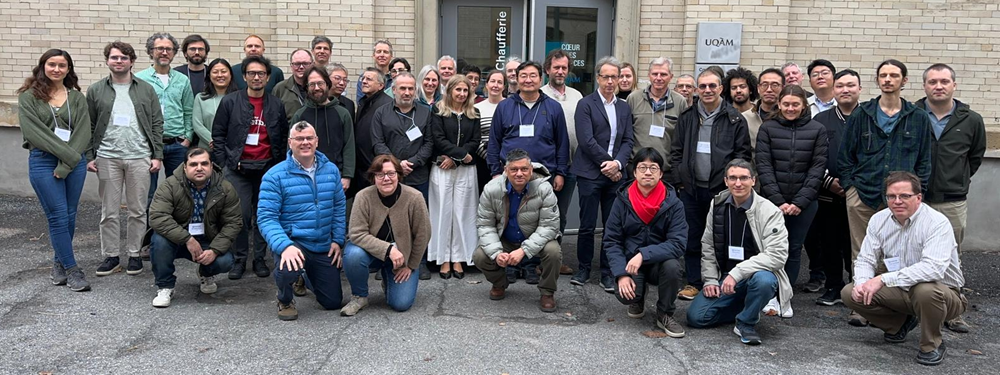
Please download the full AI-TT report here.
Executive summary
The first in-person meeting of the OceanPredict Artificial Intelligence Task Team (AI-TT) was held in Montreal in April 2026. Co-chaired by Rachel Furner (ECMWF) and Anass El Aouni (Mercator Ocean International), the event brought together researchers from various backgrounds to assess recent advances in artificial intelligence (AI) for ocean prediction. The workshop provided a forum to share progress, identify challenges, and discuss priorities for future research and operational implementation.
A central theme throughout the workshop was that AI methods are rapidly transitioning from proof-of-concept studies to operationally relevant ocean forecasting applications, mirroring developments previously seen in weather prediction. Participants presented advances across ocean model emulation, data assimilation, data reconstruction, downscaling, uncertainty estimation, forecasting, and benchmarking. At the same time, discussions repeatedly emphasized the importance of maintaining physical consistency, robust evaluation practices, and transparency in AI-based systems.
Major Scientific Themes:
Ocean Emulators and Neural Forecasting
Several presentations demonstrated the growing capability of AI-based ocean emulators to reproduce complex ocean dynamics at a fraction of the computational cost of traditional numerical models.
Mercator Ocean presented a scalable probabilistic ocean emulator capable of generating 100 years of monthly global ocean simulations in approximately 15 minutes, highlighting the potential of AI for climate scenario analysis, digital twins, and ensemble forecasting. Other studies explored machine-learning prediction of sea-surface height and currents in regional domains such as the Gulf of St. Lawrence and the East/Japan Sea. These studies demonstrated that incorporating physical constraints through physics-informed neural networks (PINNs) can significantly improve forecast stability and realism, particularly at longer lead times.
Across these presentations, participants recognized both the promise and the limitations of current approaches. While skill levels are often competitive with traditional systems for selected variables and lead times, challenges remain regarding error growth, physical consistency, and extrapolation beyond training conditions.
AI for Observations, State Reconstruction, and Data Assimilation
A second major focus was the use of AI to reconstruct ocean states from sparse observations and to complement traditional data assimilation methods.
Several presentations demonstrated how neural networks can accurately reconstruct sea-surface height, subsurface temperature and salinity, and biogeochemical variables from incomplete observations. Studies showed that models trained on data from numerical simulations or reanalysis can successfully transfer to real-world observations, often outperforming existing mapping approaches in highly dynamic regions such as the Gulf Stream and Kuroshio.
Particularly noteworthy was the development of uncertainty-aware and transformer-based architectures capable of providing both state estimates and confidence information. These approaches represent an important step toward operational deployment, where quantification of uncertainty is essential for decision-making.
Physics-Informed and Hybrid Approaches
A recurring topic was whether combining machine learning with physical knowledge provides significant benefits compared to purely data-driven approaches.
Studies demonstrated that physics-informed constraints improve the representation of currents, maintain physical balances, reduce spurious behaviour, and enhance long-range forecast skill. Hybrid approaches were also applied successfully to reconstruct ocean oxygen concentrations and biogeochemical fields from physical variables alone, substantially reducing biases in Earth System Models and improving agreement with observations.
The workshop highlighted growing interest in integrating AI directly within modelling frameworks, including parameterizations, data assimilation systems, and differentiable modelling approaches that combine physical equations and machine learning within a unified framework.
Downscaling and Coastal Applications
A number of presentations focused on the challenge of translating coarse-resolution information into detailed coastal and harbour-scale predictions.
Machine-learning approaches demonstrated promising results for statistical downscaling of sea-surface temperature, wave fields, coastal bathymetry evolution, and harbour-scale circulation. AI-based super-resolution techniques were shown to reproduce high-resolution climate and ocean information while dramatically reducing computational costs relative to traditional dynamical downscaling.
Participants highlighted that these applications may represent some of the most immediate opportunities for operational adoption of AI in ocean forecasting.
Key Challenges Identified
Despite significant progress, several common challenges emerged:
- Physical consistency: Accurate forecasts do not necessarily imply correct underlying dynamics. Multiple presentations stressed the risk of obtaining the “right answer for the wrong reason.”
- Evaluation standards: Robust and standardized benchmarking remains essential for comparing diverse AI and numerical forecasting systems fairly.
- Generalization and extrapolation: Many models perform well within their training domain but struggle under future climate conditions or unusual events.
- Uncertainty quantification: Operational use requires reliable estimates of forecast confidence and model uncertainty.
- Data limitations: Uneven observational coverage and incomplete datasets continue to constrain model development and validation.
- Computational resources: While AI can dramatically reduce inference costs, training large-scale models efficiently depends on GPU access, which is not widespread.
OceanBench: Toward a Community Benchmark
One of the most significant outcomes of the workshop was the presentation of OceanBench, a new community-driven benchmarking framework for AI and physics-based ocean forecasting systems.
Inspired by the success of WeatherBench in meteorology, OceanBench provides:
- Standardized datasets including observations, analyses, and reanalyses.
- Common evaluation protocols.
- Open-source tools and workflows.
- Leaderboards and model reports.
- Metrics that assess both forecast accuracy and physical realism.
Initial benchmarks show that AI models can already compete with operational numerical systems for some variables, particularly subsurface properties and ocean currents. Importantly, OceanBench introduces process-based diagnostics, including geostrophic currents, mixed-layer depth, and Lagrangian trajectories, to ensure models are evaluated on their physical behaviour and not solely on traditional error statistics.
Participants strongly supported the initiative and emphasized the need for community governance, transparent methodologies, and multiple independent reference datasets.
We invite submissions for the upcoming workshop, “Machine Learning for Ocean Prediction: Methods, Applications & Challenges”. This workshop aims to bring together experts and practitioners exploring the transformative role of machine learning for modelling and prediction of the ocean. Interest areas span global and regional focuses, ocean, sea ice and bio-geo-chemistry, time frames from hours to seasons and beyond, and reanalysis and data-assimilation.
Key topics of interest include (but workshop scope is not limited to the following):
- Machine Learning Emulators: Design, development, and application of machine learning, including generative approaches, as fast, surrogate models for complex ocean processes
- Hybrid Approaches: Integration of physics-based ocean models and machine learning techniques to enhance predictive accuracy and efficiency, eg. use of ML components (parameterisations, etc) in state-of-the-art physical ocean models, and combining physics and deep learning within in a single differentiable programming framework
- Deep Learning for Data Assimilation, and inversion schemes: Innovative uses of deep learning architectures to assimilate diverse oceanographic datasets, including satellite and in-situ observations. Use of ML for ocean state estimation and forecasting.
- Evaluation Challenges: Strategies and benchmarks for assessing the performance, robustness, and reliability of deep learning-based emulators in operational settings.
- Technical challenges: Operationalization, Novel architectures, Managing and sharing large datasets, etc.
- Other relevant ML applications for Ocean prediction (e.g. downscaling applications, ensemble forecasting)
We encourage contributions in the form of oral presentations and posters. Submissions should clearly outline objectives, methodologies, and relevance to the workshop themes.
Join us to advance the science of ocean prediction through cutting-edge machine learning approaches!
Please note that everyone who is planning to attend the AI-TT meeting must register using the link below.
If you like to submit an abstract you have to use the abstract submission form in addition.
| REGISTRATION
NOW CLOSED
|
ABSTRACT SUBMISSION
NOW CLOSED You can upload a maximum of 2 abstract. The abstract should be provided as a .doc or .docx file, be no longer than 300 words and should ideally not include a graphic. Please view a simple template here. |
All submitted abstracts are available in the table below in pdf format (some exceptions).
Sorted alphabetically by author.
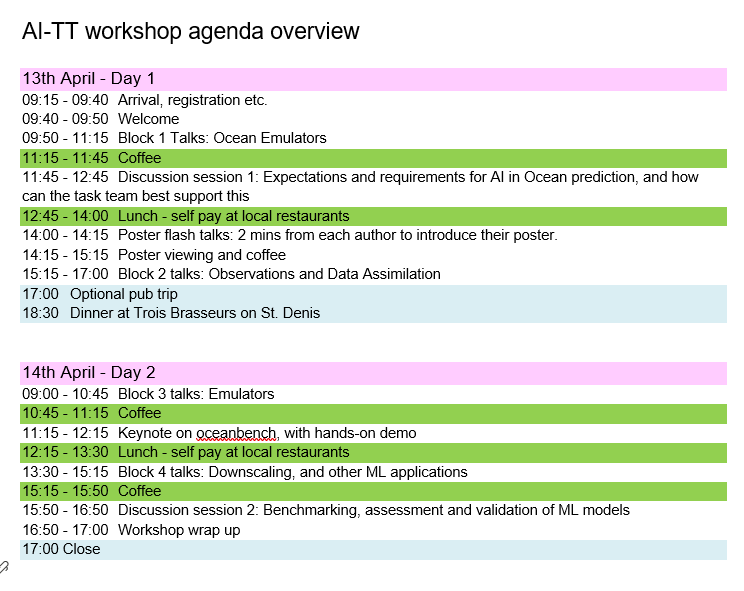
You can download the latest agenda version here (14 April 2026)
(It includes the presentation assignments but no fixed times yet.)
Agenda overview
Keynote presentation
Chair: Fraser Davidson (ECCC), Rapporteur: Kristian Mogensen (ECMWF)
| OceanBench: A Benchmark for Data-Driven Global Ocean Forecasting systems | Anass El Aouni | Mercator Ocean International | Recording |
Block 1 talks: Ocean Emulators
Chair: Rachel Furner (ECMWF), Rapporteur: Anass El Aouni (MOI)
| Toward Scalable and Probabilistic Neural Ocean Forecasting (not avialable) | Simon van Gennip | Mercator Ocean International, France | Recording |
| Application of Deep learning (DL) in the Gulf of St. Lawrence and Estuary | Francois Roy | ECCC, Canada | Recording |
| Prediction of sea surface currents around the Korean peninsula using artificial neural networks | Jae-Hun Park | Department of Ocean Sciences, Inha University, Republic of Korea | Recording |
Block 2 talks: Observations and Data Assimilation
Chair: Jae-Hun Park (Inha University), Rapporteur: Vikram Khade (ECCC)
| Training end-to-end neural mapping schemes from simulation data for the reconstruction of global-scale sea surface fields | Daniel Zhu | IMT Atlantique, France | Recording |
| Short-term neural forecasts of ocean dynamics from sparse satellite observations | Daria Botvynko | IMT Atlantique, France | Recording |
| Two-Phase CNN for Model Data Fusion: Predicting 3D Chlorophyll-a in the Mediterranean Sea | Teresa Tonelli | OGS, University of Trieste, Italy | Recording |
| A Deep-Learning Observation Operator for Subsurface Thermohaline Reconstruction from Satellite Surface Observations | Geon Min Lee | Pukyong National University, Republic of Korea | Recording |
| AI perform on high resolution three-dimensional ocean forecasting: remote sensing data driven becomes a new possibility | Liying Wan | NMEFC, China | Recording |
Block 3 talks: Emulators
Chair: Charlie Hebert-Pinard (ECCC), Rapporteur: Daniele Bigoni (CMCC)
| Linear Stochastic Emulators of the Ocean Circulation – A Lesson, perhaps, for Machine Learning | Andrew Moore | University of California Santa Cruz, US | Recording |
| A data driven limited area storm surge model | Mateusz Matuszak | Norwegian Meteorological Institute, Norway | Recording |
| A Physics Informed Emulator for Ocean Oxygen (remote presentation) | Annalisa Bracco | CMCC, Italy | Recording |
| Application and Verification of the Global Wave Intelligent Forecast Model | Fang Hou | NMEFC, China | Recording |
Block 4 talks: Downscaling, and other ML applications
Chair: Frederic Dupont (ECCC), Rapporteur: Simon Corbeil-Letourneau (ECCC)
| Development of machine-learning emulators for harbour-scale ocean prediction | Michael Dunphy | Institute of Ocean Sciences, Fisheries and Oceans Canada | Recording |
| From Coarse Models to Coastal Detail: A Deep Learning Approach to AI based Statistical Downscaling in the Adriatic Sea (remote presentation) | Alessandro De Lorenzis | CMCC, Italy | Recording |
| Integrated AI_Physics Approaches for Coastal Prediction Across the Open-to-Coastal Ocean Continuum | Joanna Staneva | Helmholtz Zentrum HEREON, Germany | Recording |
| Fix the double penalty in data-driven forecasting by modifying the loss function | Christopher Subich | ECCC. Canada | Recording |
| Variational autoencoder-based clustering for geophysical fluid circulations with small sample size | Kunihiro Aoki | Meteorological Research Institute, Japan Meteorological Agency | Recording |
Posters
Chair: Anass El Aouni (MOI)
| Filling the Ocean’s Gaps: a Self-Supervised Neural Network for Argo Profiles Data Augmentation | Teresa Tonelli | OGS, University of Trieste, Italy | Flash talk: Pdf and recording |
| Assimilation of sea surface temperature in the Mediterranean Sea using ML-based operators | Daniele Bigoni | CMCC, Italy | Flash talk: Pdf and recording |
| Bridging Scales in Mediterranean Biogeochemical Prediction: A High-Order Ensemble Assimilation Coupled with AI-Driven Downscaling | Simone Spada | OGS, Italy | Flash talk: Pdf and recording |
| Data-driven ocean modelling at ECMWF | Rachel Furner | ECMWF | Flash talk: Pdf and recording |
| Physics-Informed Neural Data Assimilation for High-Resolution: Coastal SPM Reconstruction from Model and Satellite data | Wei Chen | Helmholtz-Zentrum Hereon | No flash talk or recording available |
| Toward an AI-enhanced hydro-morphodynamic model for nature-based solutions in coastal erosion mitigation (abstract only) | Nour Dammak | Helmholtz-Zentrum Hereon | No flash talk or recording available |
Discussion session 1: Expectations and requirements for AI in Ocean prediction, and how can the task team best support this
Chair: Gregory Smith (ECCC), Rapporteur: Rachel Furner (ECMWF)
Discussion session 2: Benchmarking, assessment and validation of ML models
Chair: Rachel Furner (ECMWF), Rapporteur: Simon Van Gennip (MOI)
Local information about venue, accommodation and transport
Transport
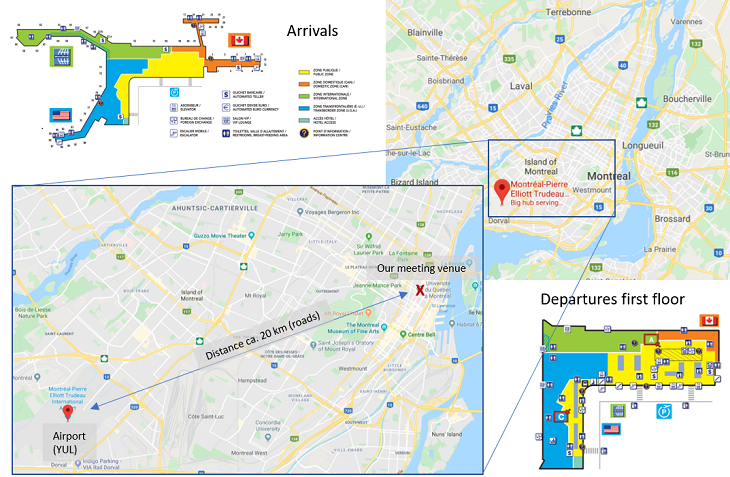
The Montreal International Airport (Pierre Elliott Trudeau – YUL) is conveniently located to the Southwest of Montreal in close proximity to the city centre.
The shuttle bus line “747” runs a 24/7 dedicated service to get you from the airport to downtown Montreal. Detailed information about the route and timetable can be found on the STM 747 website. Tickets for the bus are 10$, and can be purchased at airport ticket machines, from metro stations, kiosk and also from the driver, but only if you have exact change (coins only).
Alternative transport is available by taxi, Uber, etc. Information about routes and costs can be found here.
Flight connections to Montreal are very good, with many destinations being direct. Please check here if your airport directly connects to Pierre Trudeau airport (YUL).
If you booked a room at the Double Tree by Hilton, the best connection from the airport is to use the bus 747-2 and vacate the bus at Rene-Levesque / Jeanne-Mance. From there it is a 2 min walk to the hotel entrance. Please check for updates on fares and bus schedule.
Accommodation
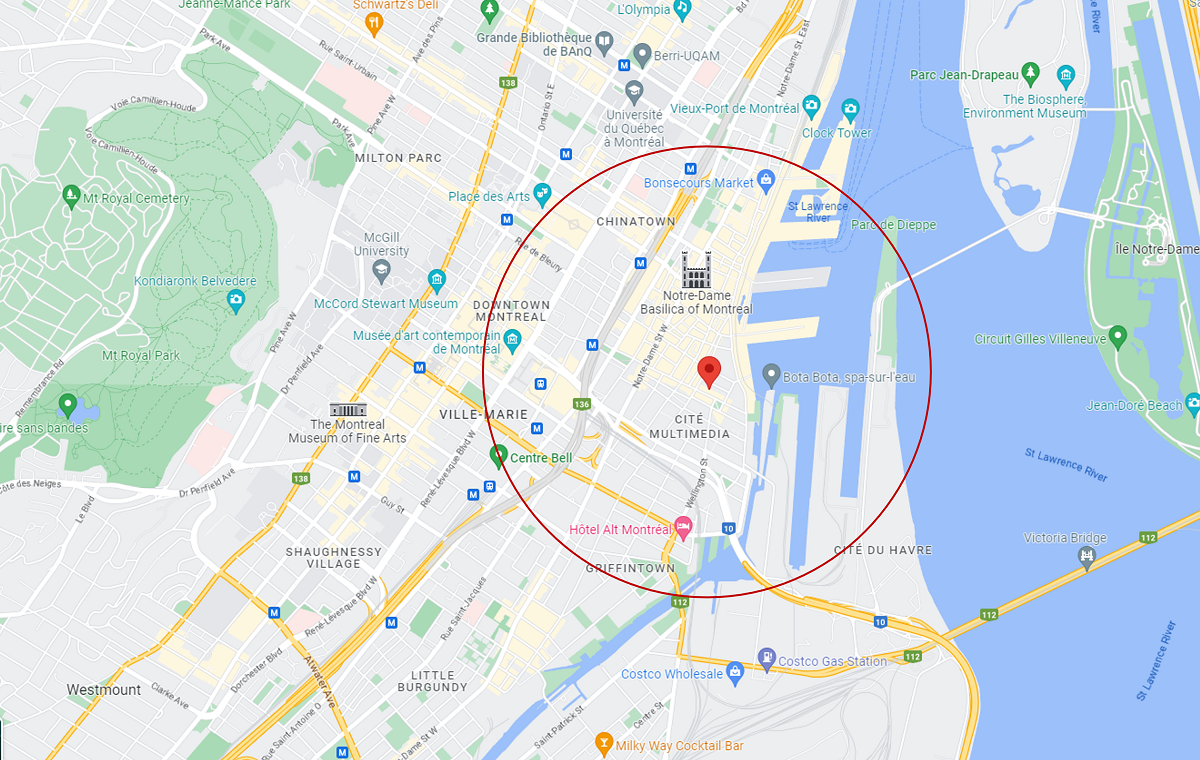 Click to enlarge
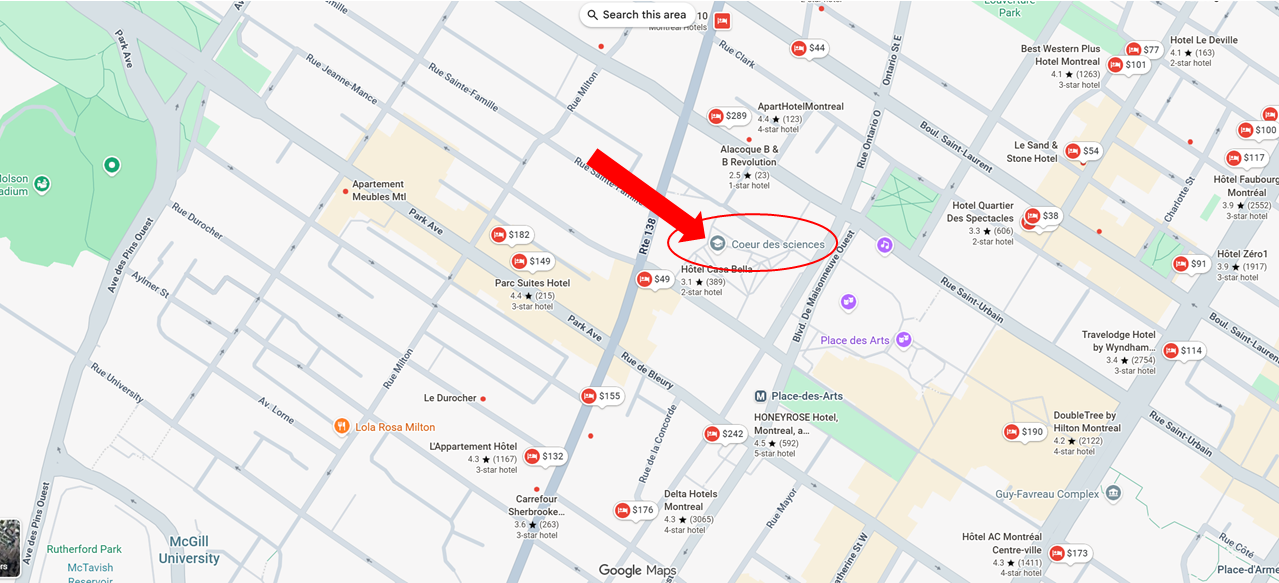
There are many hotels near the meeting venue. Prices are reasonable considering we are in one of the second largest city in Canada. The map (right) shows the location of our venue. Please check this link to view some of the hotels available nearby.
To book these hotels please make your own arrangements, by using the associated website and booking portals.
Montreal
Montreal is the most populous municipality in the Canadian province of Quebec and the second-most populous municipality in Canada. It is named after Mount Royal, the triple-peaked hill in the heart of the city. The city is centred on the Island of Montreal a few much smaller peripheral islands, the largest of which is Île Bizard. It has a distinct four-season continental climate with warm to hot summers and cold, snowy winters.
French is the city’s official language and is the language spoken at home by almost 50% of the city population, followed by English at 22.8% and 18.3% other languages. This makes Montreal one of the most bilingual cities in Quebec and Canada, with over 59% of the population able to speak both English and French.
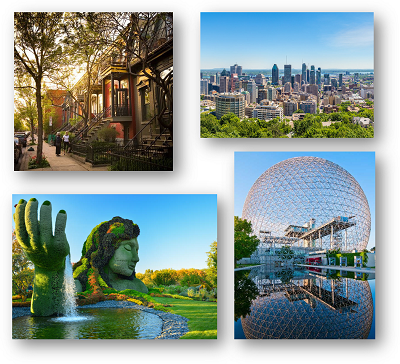
Our meeting venue is very close to Old Montreal, a historic area southeast of downtown containing many attractions such as the Old Port of Montreal, Place Jacques-Cartier, Montreal City Hall, the Bonsecours Market, Place d’Armes, Pointe-à-Callière Museum, the Notre-Dame de Montréal Basilica, and the Montreal Science Centre.
Architecture and cobbled streets in Old Montreal have been maintained or restored and are frequented by horse-drawn buggies carrying tourists. Old Montreal is accessible from the downtown core via the underground city and is served by several STM bus routes and Metro stations, ferries to the South Shore and a network of bicycle paths.
The riverside area adjacent to Old Montreal is known as the Old Port. The Old Port was the site of the Port of Montreal, but its shipping operations have been moved to a larger site downstream, leaving the former location as a recreational and historical area maintained by Parks Canada. The new Port of Montreal is Canada’s largest container port and the largest inland port on Earth.
(Source: Wikipedia)
| Date | Description |
|---|---|
| September 2025 | Save the date announcement |
| 28 October 2025 | Opening of Call for abstracts |
| 2 January 2026 | Call for abstracts closes – now closed |
| Mid-Jan 2026 | Registration opens |
| End-Jan 2026 | Abstract confirmation & early schedule announcement |
| Mid-February 2026 | Registration deadline |
| 13 & 14 April 2026 | Workshop |
- AI-TT co-chairs
- Santha Akella, NOAA
- Rachel Furner, ECMWF
- AI-TT members
- Kristian Mogensen, ECMWF
- Simon van Gennip, MOi
- OPST co-chairs
- Marie Drevillon, MOi
- Greg Smith, ECCC
- Local host
- Greg Smith, ECCC
- Frederic Dupont, ECCC
- Fraser Davidson, ECCC
- OP programme office
- Stephanie Cuven, MOi
- Kirsten Wilmer-Becker, Met Office