IV-TT meeting – Nov 2026: Intercomparison and Validation of Ocean Forecasts and Predictions at Global and Regional Scales

The Intercomparison and Validation Task Team (IV-TT) designs, tests, and publishes advanced methods for verifying and validating the quality of operational ocean products with the aim to determine skills, strengths and weaknesses of ocean analysis and forecasting systems. The team coordinates and promotes scientific validation and intercomparison activities among operational centres, with the objective to establish best practices.
- In-person meeting (with possible hybrid option)
- 11-13 November 2026 (3-day meeting, Wed-Fri)
- Shanghai, China
This meeting should bring together operational ocean forecasting and prediction centres, users of ocean forecasts, and the broader scientific community to exchange knowledge on current intercomparison and validation practices across different forecasting systems. Our understanding of ocean from large and decadal scales to submesoscale is growing with new observing capabilities, finer resolution and more dedicated numerical tools, including biogeochemistry and biodiversity surveys.
The meeting will provide a platform to review and compare existing methodologies, identify gaps, and discuss emerging challenges in the evaluation of ocean forecasts. In particular, it aims to support the advancement of intercomparison and validation metrics (e.g. Class 4 metrics) to better address the rapidly evolving landscape of ocean forecasting systems, including the growing role of AI-based approaches.
Through these discussions, the meeting seeks to foster collaboration and contribute to the development of more robust, user-oriented, and future-proof validation and evaluation frameworks.
This workshop is open to the entire ocean forecasting and prediction community, including operational centres, research institutions, service providers, and users of ocean forecast products.
We particularly encourage participation from operational centres involved in the validation and verification of ocean forecasting and prediction systems to share experiences, discuss current practices, and contribute to the development of future evaluation methodologies and metrics.
IV-TT members are expressly invited to attend and actively contribute to the discussions. Designated substitutes are also welcome to participate on their behalf.
Scientific topics / themes
The main focus of the workshop is on evaluation and verification methods and metrics for ocean forecast and prediction systems. We invite contributions on the following topics to help the community better understand existing validation and verification approaches, identify current challenges, and discuss future developments in the field:
- Evaluation and validation methods for numerical ocean forecast systems and AI-based ocean forecast systems
- Intercomparison of numerical model-based and AI-based ocean forecast systems
- Evaluation and validation of ensemble ocean forecasts and prediction systems
- Validation and verification metrics for ocean forecasts (e.g. Class-1, Class-2, Class-3 and Class-4 metrics) and their future development
- Evaluation of regional and global ocean forecast systems
- User-oriented validation metrics and impact assessment for operational applications (e.g. offshore energy, marine safety, fisheries and shipping)
- Evaluation of forecast skill for extreme and high-impact ocean events
- Observational datasets and reference products for ocean forecast validation
- Uncertainty quantification and reliability assessment of ocean forecasts
- Novel approaches and emerging methodologies for ocean forecast evaluation and verification
- Best practices, quality assurance frameworks, and international standards for ocean forecast validation
- Evaluation of ocean forecast systems using next-generation satellite observations (e.g., SWOT)
The agenda will be set up after all abstracts have been received and processed. Abstract submitters will be informed about the abstract selection by mid/end August.
We plan for a 2.5-day schedule, and would like to use the remaining half-day to a visit Fudan University.
Agenda draft now available
(latest version: 4 Nov 2026)
The agenda now includes the daily Team links.
Abstracts
Click on title to download abstracts. Not all abstracts are available.
| No | First name | Last name | Affiliation | Abstract title | Presentation type |
|---|---|---|---|---|---|
| 1 | Furqon | Alfahmi | Indonesian Agency for Meteorology Climatology and Geophysics (BMKG) | Advancing Indonesia’s Operational Coupled Ocean Forecasting System through Ensemble Data Assimilation: Initial Results from InaCAWO | Oral |
| 2 | Amani | Ali | Egyptian Meterological Authority | Validation of SWAN Wave Simulations during a Mediterranean Medicane Using Multi-Source Observations | Poster |
| 3 | Stefania | Ciliberti | NOW Systems | How an Operational Validation Framework Supports Reliable Regional Forecasts and Coastal Services | Oral |
| 4 | Emanuela | Clementi | CMCC | The Mediterranean and Black Seas forecasting physical systems: description and validation assessment | Oral |
| 5 | Anass | El Aouni (1) | Mercator Ocean International | Evaluation of machine learning-based ocean forecasting systems for extreme marine events: the IBI-Mediterranean marine heatwave of spring 2 | Poster |
| 6 | Anass | El Aouni (2) | Mercator Ocean International | Understanding AI Ocean Forecasting Models Through Controlled Perturbation Experiments | Poster |
| 7 | Yosuke | Fujii | JMA/MRI | UN Ocean Decade Project SynObs and its potential Collaboration with IV-TT | Oral |
| 8 | Sang-Hun | Jeong | Korea Institute of Ocean Science and Technology | A Multi-Variable Class-4 Verification-Uncertainty Budget for Operational Ocean-Forecast Skill with CMEMS In Situ Observations | Oral |
| 9 | Jiawei | Jiang | Laoshan National Laboratory | Physics-AI Collaborative Evaluation-Prediction Framework for Rapid Underwater Acoustic Transmission Loss Modeling | Oral |
| 10 | Zhao | Jing | OUC/Laoshan | WenHai: An End-to-End AI-Based Global Eddy-Resolving Ocean Forecast System | Oral |
| 11 | Yvonnick | Le Clainche | Fisheries and Oceans Canada | New reference SST and T/S profiles datasets for Class-4 verification and intercomparison of global ocean forecast system | oral |
| 12 | Zhijin | Li | Department of Atmospheric and Oceanic Sciences, Fudan University | Prediction and Reanalysis from a Mesoscale Data Assimilation and Forecasting System for the Pacific Ocean | Oral |
| 13 | Gabriela | Martinez Balbontin | Mercator Ocean International | What should a biogeochemical forecast be calibrated against? | Oral |
| 14 | Ziyue | Meng | Ocean University of China, Qingdao | A global 3D chlorophyll-a dataset derived from multimodal deep-learning reconstruction | Oral |
| 15 | Shun | Ohishi | RIKEN | LETKF-based Ocean Research Analysis (LORA) version 2 for a quasi-global domain (LORA-QG) | Oral |
| 16 | Lalu Mantigi Wana | Paksi | Academia Sinica and National Taiwan University | Ocean Data Assimilation System for the TIMCOM GEPSv3 Coupled Prediction System: Development, Tuning, and Multi-model Evaluation | Poster |
| 17 | Christine | Pequignet | Met Office | Verification of Ocean Forecasts with Spectral Analysis | Oral |
| 18 | Fangli | Qiao (1) | FIRST INSTITUTE OF OCEANOGRAPHY | Forecasts and evaluation of Strong Tropical Cyclones Improved by Incorporating Ocean Surface Waves at Air-Sea Interface | Oral |
| 10 | (Fangli) Pin |
(Qiao (2)) Li |
FIRST INSTITUTE OF OCEANOGRAPHY | Long-term evaluation of FIO-COM: predictive skill, biases, and future outlook | Oral |
| 20 | Charly | Regnier | Mercator Ocean International | A comparative validation study based on process-oriented metrics for Mercator’s deterministic, global and data-driven systems | Oral |
| 21 | Gregory | Smith | ECCC | Near Real-time Evaluation of Operational Oceanographic Predictions: Over a Decade of Intercomparison by Global Ocean Forecasting Centers | Oral |
| 22 | Xiang | Wang | National University of Defense Technology | The End-to-end AI-Based Global Ocean Forecasting System XiHe and Its Intercomparison Evaluation | Oral |
| 23 | Jiuke | Wang | Zhongshan University | Remote Sensing Data-Driven Ocean Prediction and the Exploration of Spaceborne Computing | Oral |
| 24 | Chunxue | Yang | CNR-ISMAR | MER-EP: a Marine Environment Reanalysis Evaluation initiative fostering synergies with observation-based approaches for enhanced ocean monitoring | Oral |
| 25 | Keyi | Yang | Zhejiang University | A Deep Learning Model for Three-Dimensional Chlorophyll-a Forecasting in the Upper Ocean of the North Pacific |
Poster |
| 26 | Nan | Yang | Institute of Oceanology of the Chinese Academy of Sciences | LangYa: A Large AI model for Global OceanForecasting | Oral |
| 27 | Shijin | Yuan | Tongji University | TongHai: Towards Physics-AI Hybrid Modeling With Explicit Physical Guidance And Dual Neural Networks | Oral |
| 28 | Yuhang | Zhu | CAS | Volador 1.0: A Data-Driven Air-Sea Full-Coupling Regional Forecast Model with Submesoscale-Permitting Based on MOE-Swin-Transformer framework | Oral |
| 29 | Ziqing | Zu | National Marine Environmental Forecasting Center | Beyond Statistical Accuracy: How Should We Evaluate AI Ocean-State-Forecasting Models? | Oral |
Please note that everyone who is planning to attend the IV-TT meeting must register.
If you like to submit an abstract you have to use the abstract submission form in addition.
| REGISTRATION
Registration will remain open until Fri, 30 October 2026 |
ABSTRACT SUBMISSION
Now closed You can upload a maximum of 2 abstract. The abstract should be provided as a .doc or .docx file, be no longer than 300 words and should ideally not include a graphic. Please view a simple template here. |
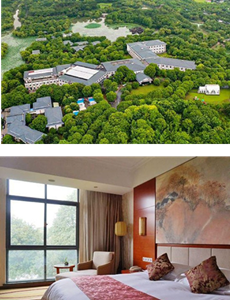 Aerial view of the hotel and room example
- Hotel/ venue: The meeting will be held at the Hengshan Park Hotel in Shanghai. We are planning to reserve rooms for attendees.
- Icebreaker: We are planning to arrange an icebreaker/reception for all attendees.
- Remote Presentations: We will arrange for an online meeting to support remote presentations and streaming.
- Catering: We will provide free tea breaks and lunches for all attendees.
- Airports: There are two international airports in Shanghai. Shanghai Pudong International Airport (PVG) and Shanghai Hongqiao International Airport (SHA). Shanghai Pudong (PVG) is located about 55 km east of downtown Shanghai. It handles most international flights and serves as a major hub for long-haul flights to and from Asia, Europe, the U.S., and other parts of the world. Shanghai Hongqiao (SHA) is situated around 25 km west of downtown, and primarily used for domestic flights and some regional international routes.
- Transfer: If participants’ flight arrival times are relatively concentrated, we can arrange a shuttle bus transfer from the airport to the hotel. Both airports have airport express trains and metro lines available. From Pudong Airport, you can take the airport express rail and then transfer to Metro Line 15. From Hongqiao Airport, take Metro Line 2 and switch to Line 15.
Updated: 5 August 2026
| Important dates | Description |
|---|---|
| 4 June 2026 | Call for abstracts open |
| 4 September 2026 | Call for abstracts close (extended deadline) |
| Mid-Sep 2026 | Registration open |
| Mid-Sep 2026 | Abstract confirmation |
| 30 September 2026 | Registration close |
- Program Organising Committee:
- Ocean Predict intercomparison and validation task team co-chairs: Chunxue Yang (CNR), Stefania Ciliberti (NowSystems) and Babette Tchonang, NRL
- Ocean Predict AI task team co – chairs
- OceanPredict co-chairs: Greg Smith (ECCC) and Marie Drevillon (MOI)
- Ocean Predict programme office: Kirsten Wilmer-Becker (Met Office)
Local Organising Committee:
- National Marine Environment Forecast Center of China: Liying Wan (NMEFC)
- Fudan University
Organising Committee pages – login required