Joint CP-TT/DA-TT Workshop

Overview

The OceanPredict task teams on Coupled Predictions (CP-TT) and Data Assimilation (DA-TT) are organizing a
Joint CP-TT/DA-TT Workshop at ECMWF, UK
“Advances in coupled modeling, data assimilation, and predictions”
The workshop will bring together a wide range of scientists and experts in ocean coupled prediction and data assimilation.
—- Registration NOW CLOSED —-
The Data Assimilation-Task Team (DA-TT) fosters the development and evaluation of data assimilation systems relevant to OceanPredict to support the coordination of the fundamental and challenging issues in the ocean forecasting process, of which data assimilation is a significant part.
The Coupled Prediction-Task Team (CP-TT) is engaged in the development and advancement of earth system coupled models to improve predictions across a range of time-scales. Particular focus is on the role of the ocean in coupled models, their initialization and predictions and how the ocean influences other components (e.g., atmosphere, land, sea ice, waves, bio-geo-chemistry, etc).
Date and time
- In-person meeting (with possible hybrid option)
- 26-30 October 2026 (4 – 5 days)
- ECMWF, Reading, UK
Objectives
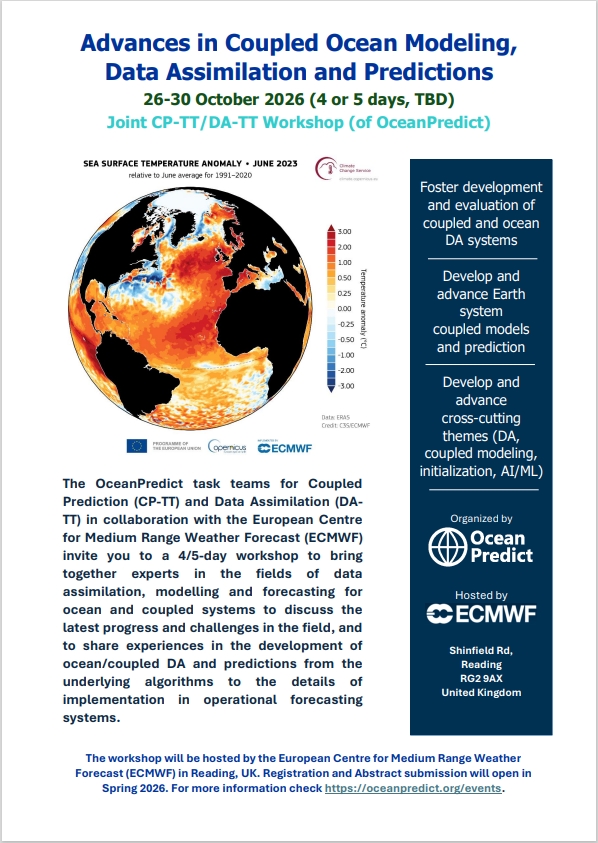
The DA-TT and the CP-TT are organizing a Joint workshop at ECMWF on Advances in coupled modeling, data assimilation, and predictions to
- foster development and evaluation of coupled and ocean DA systems
- develop and advance Earth system coupled models and prediction
- develop and advance cross-cutting themes (DA, coupled modeling, initialization, AI/ML)
This meeting aims to bring together experts in the field of ocean, coupled data assimilation (DA) and coupled modeling and forecasting to discuss the latest progress and challenges in the field, and to share experiences in the development of ocean/coupled DA and predictions from the underlying algorithms to the details of implementation in operational forecasting systems.
A short “white” paper covering the issues and recommendations will be submitted for publication following the meeting.
Flyer
Agenda
Download full agenda draft (including speakers and the list of posters).
Latest version: 27 August 2026
(We will update it as we get closer to the event)
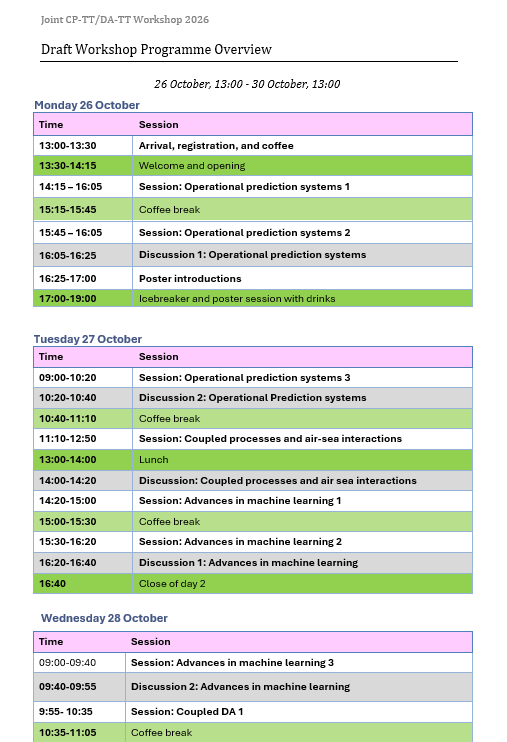
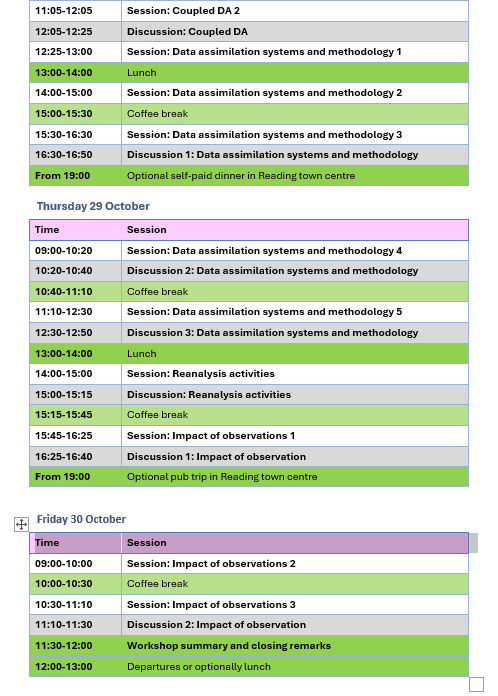
Agenda overview
Themes
The workshop covers themes in the areas of the OceanPredict Task Teams CP-TT (coupled prediction) and DA-TT (data assimilation) and also cross-cutting aspects.
Please see details below:
- DA-TT (data assimilation)
- CP-TT (coupled predictions)
- Cross- cutting
- DA-TT:
- 1.1 Status of ocean-focused DA in operational forecasting, reanalysis systems, digital twins and climate prediction from global to regional and coastal systems.
- 1.2 Advances in DA methods (ensembles, algorithms, machine learning, downscaling, error covariance modeling, etc).
- 1.3 Observing systems: requirements, evaluation, design and associated DA developments.
- 1.4 Software infrastructure and efficient use of DA on HPCs for ocean/coupled DA.
- CP-TT:
- 2.1 Science of coupling for improving predictions at different time scales: weather- medium, sub-, seasonal scales. Complexity and challenges involved in medium- and seasonal-range predictions.
- 2.2 Physical and dynamical consistency in coupling across earth system models and analyses.
- 2.3 Representation of coupling feedbacks in earth systems models with different levels of complexity of individual components (parameterized vs resolved processes). Clarification of the key choices for (ocean) model configurations and parameterizations.
- 2.4 Advances in coupling software infrastructure on current and future HPCs.
- Cross- cutting:
- 3.1 Use of DA to improve models and reduce model error. Initialization of Earth system models (algorithm advancements, status, applications for seasonal and climate projections). DA for estimation of model parameters. Appropriate covariances for coupled models at high resolutions.
- 3.2 Role of coupling and/or DA in the representation of extreme events (hurricanes, cyclones, marine heat waves, etc) and their predictions.
- 3.3 Impact of ocean observations on coupled forecasts. Novel use of observations to improve coupled predictions, e.g., how to best use observations sensitive to the interface between the ocean and the atmosphere (for instance satellite radiances sensitive to ocean skin salinity/temperature)?
- 3.4 Changing role of DA in the face of AI models and digital twins and integration strategies of AI and DA/coupled modelling.
- 3.5 Coupled models and DA (e.g., ocean/atmosphere/sea-ice, physics/biogeochemistry, physics/acoustics) in the representation of carbon cycle. From earth system to regional scale models: marine carbon dioxide removal and related physical and biogeochemical processes: current status and improvements.
- 3.6 Use of AI/ML in the ocean prediction system (both DA and CP).
- 3.7 Contributions from the coastal community.
Abstracts
All submitted abstracts are available in the table below in pdf format.
Sorted alphabetically by author.
Attendance
Members of the two task teams (CP-TT and DA-TT) are warmly invited to the meeting, but also
- attendees of previous DA-TT or CP-TT events
- Members of the wider OceanPredict community
- researchers who work in the field of ocean, coupled data assimilation (DA) and coupled modeling and forecasting
- Junior scientists and graduate students are very much encouraged to attend.
CP-TT and DA-TT members or their substitutes are expressly invited to attend.
Format
- In-person participation is encouraged for the sake of enhanced interaction.
- In case one can not join in-person, virtual participation is possible- more details will be provided at a later stage.
Online access to workshop
MS Teams links to meeting
Workshop access will be available online via MS Teams. Links to the presentations will be sent to all participants. We will have one link per day.
All presentations will be recorded. We will try our best to give remote participants the opportunity to participate as much as possible both in questions to speakers and the discussion session.
Registration and abstract submission
Please note that everyone who is planning to attend the Joint CP-TT/DA-TT workshop must register.
If you like to submit an abstract you have to use the abstract submission form in addition.
| REGISTRATION
NOW CLOSED Participation in this workshop is free of charge. It will run from 26/10/2026 – 30/06/206 (lunchtimes). The workshop will be an on-site event with the option to stream presentations. If you are participating remotely you are still required to register. Presenting work remotely will only be possible in exceptional circumstances. |
ABSTRACT SUBMISSION
NOW CLOSED You can upload a maximum of 3 abstract. The abstract should be provided as a .doc or .docx file, be no longer than 300 words and should ideally not include a graphic. Please view a simple template here. |
Venue, access and lunches
ETA
Be aware that the United Kingdom requires electronic travel authorisation (ETA) to visit the UK even for people who don’t need visas. Here is a link to apply: https://www.gov.uk/eta.
Venue
The workshop will be held at ECMWF’s Reading office. Information on how to get to ECMWF can be found on: https://www.ecmwf.int/en/about/location/ecmwf-reading.
When arriving on the first day please give your name to the security guard at the gate and you will be given access to the site. Please make your way to the Weather Room on the first day where registration takes place. On the following days please show your badge to the security guards and sign in at the reception.
The ECMWF restaurant is open for light breakfasts from 08.00 and will be open for lunch service during the lunch breaks specified on the programme. Lunches etc will be self-paid. Daily menus will be displayed in the restaurant. As it is a staff restaurant, a 10% increase to prices will be applied for visitors. The restaurant can only accept chip and pin, and contactless card payments. They cannot accept cash.
Reception & social events
Reception on Monday
We will have a welcome drinks reception with the poster session on Monday evening in the Weather Room. The event is with compliments of ECMWF and is free to attend for all those registered for the meeting.
Social events
We have two other social events.
- A self-funded dinner on Wednesday Evening (Oct 28) at Côte Brasserie in the Reading Town Centre has been arranged. Here is a link to pre-order your food: https://events.ecmwf.int/event/538/registrations/457/https://events.ecmwf.int/event/538/registrations/457/. Deadline for registering is the October 19th and you will have to pay at the restaurant with a card.
- An informal pub trip (also self-funded) at The Fisherman’s Cottage is planned for Thursday Evening. Please register here if you would like to join: https://forms.cloud.microsoft/Pages/ResponsePage.aspx?id=xhG3IbeqNk2f-6wDV7wguicrcCA890ZHgu6abTQxAbtUQkZQQklXN1NOWlhBTTlIVTRaSkEwQU5FTC4u
Important dates
| Date | Description |
|---|---|
| April 2026 | Save the date announcement |
| 7 May 2026 | Opening of Call for abstracts |
| 3 July 2026 | Call for abstracts closes (extended deadline) |
| 2 July 2026 | Registration opens |
| 21 July 2026 | Abstract confirmation emails |
| 11 September 2026 | Registration deadline |
| 26-30 October 2026 | Workshop |
Organising committee
Scientific Organising Committee
(in no particular order)
- Kristian Mogensen (ECMWF)
- Hao Zuo (ECMWF)
- Phil Browne (ECMWF)
- Sarah Keeley (ECMWF)
- Marcin Chrust (ECMWF)
- Anthony Weaver (CERFACS)
- Andrew Moore (UCSC)
- Ann Kristin Sperrevik (Met.no)
- Santha Akella (NOAA)
- Sergey Frolov (NOAA)
- Joao Souza (NOAA)
- Matthew Martin (Met Office)
- Chris Harris (Met Office)
- Kirsten Wilmer-Becker (Met Office)
- Anna Teruzzi (OGS)
- Stephanie Cuven (MOI)
Organisation space (login needed)
We have set up a private organisation page to the Joint CP-TT/DA-TT meeting Organising Committee (login needed – please contact programme office from more details).